← BACK TO DOSSIERS LIST
REALISM CASE FILE // TREND: PROMPTING HISTORICAL SCENES: AUTHENTIC TIME WEAR AND ANTIQUE TEXTURES
Photo-Realism Calibration for Aged Letters: Building Camera-Grade Authenticity Through Physical Evidence
DATE: 2026-07-08
STATUS: CALIBRATED_REALISM
ENGINE: CHATGPT DALL-E 3
SPECIMEN IMAGE #16:9 - CLEAN OPTICS
Artificial image generation often defaults to polished nostalgia instead of documenting how physical objects actually age. Old letters are frequently rendered with uniform yellow tones, perfectly distressed edges, and decorative lighting that feels manufactured rather than observed. Genuine realism begins by recognizing that every sheet records a different history of handling, oxidation, moisture, folding, and storage.
In the sections above, we break the scene into observable physical layers instead of aesthetic shortcuts. Each layer isolates measurable behavior—from paper fibers and environmental light to gravity and material fatigue—but the deeper advantage appears later. The real breakthrough in camera-grade simulation comes from language itself, where subtle vocabulary replacements revealed in the calibration console reshape how image models interpret physical evidence.
Lexicon shifts replace generalized artistic terms with measurable descriptions that correspond to real-world behavior. Instead of requesting vintage beauty, the calibration specifies oxidation, fiber separation, humidity deformation, localized stains, uneven discoloration, and realistic optical response. These changes improve physical plausibility because the prompt references observable material processes instead of visual style, producing imagery that better reflects documentary photography.
The result is an image driven by evidence rather than decoration, returning to the original goal of portraying old correspondence as authentic physical artifacts instead of aesthetic props. If you want to push this calibration approach further, explore the complete methodology in the ALPHA REALISM guide, where film-style prompt construction is expanded into a repeatable workflow. The complete reference manual available through ALPHA REALISM explains how layered physical analysis and lexicon calibration combine to produce consistently camera-grade realism.
The 5 Layers of Reality Applied
Subject:
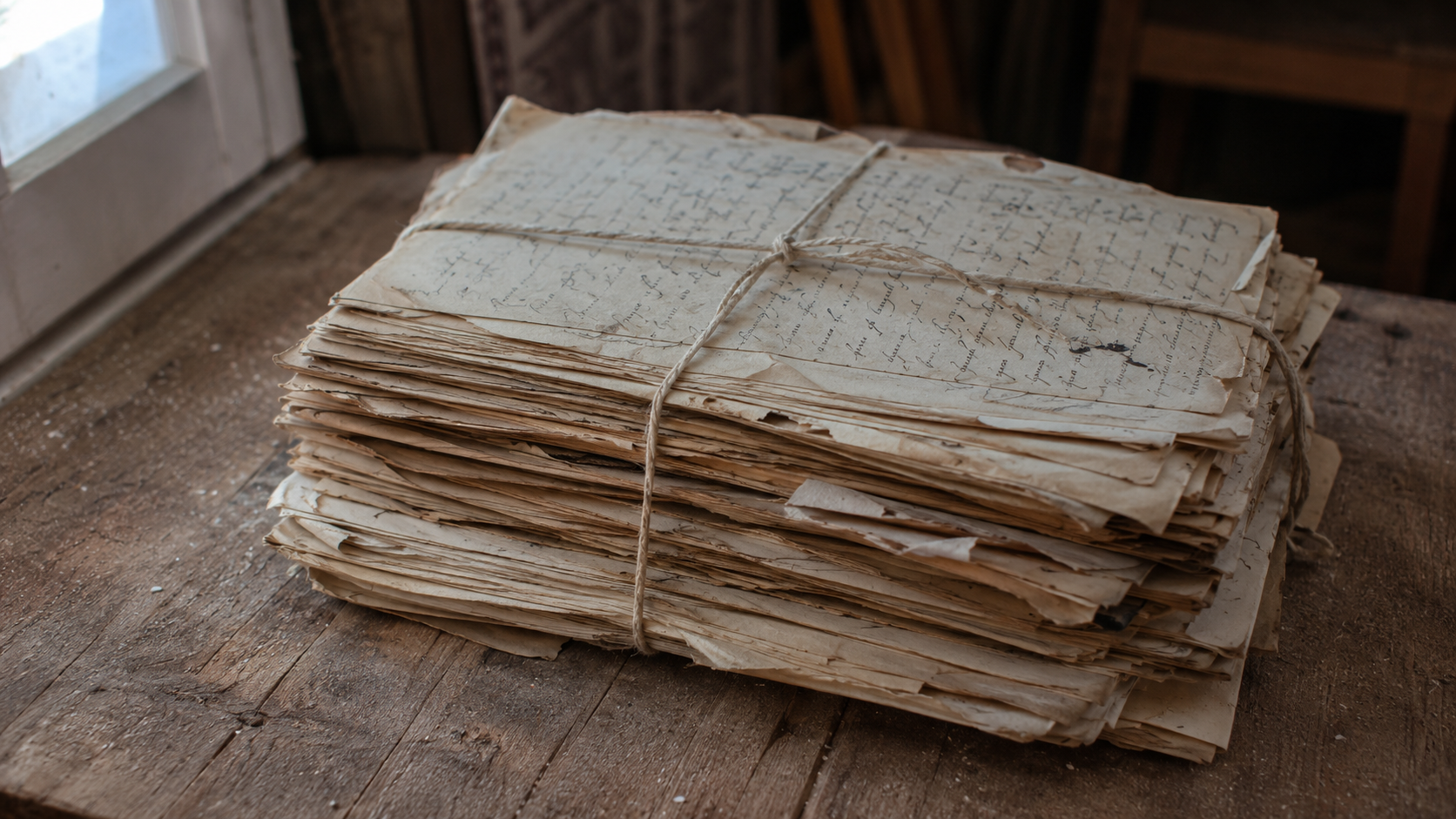
A stack of old yellowed handwritten letters tied loosely with a faded cotton string. The paper sheets vary slightly in size and alignment, with curled corners, frayed edges, folded creases, uneven oxidation, scattered ink stains, faint fingerprints, minor tears, softened fibers, and partially faded handwriting remaining naturally legible in some areas while disappearing in others.
Environment:
The letters rest on a worn wooden tabletop with accumulated dust inside shallow grain patterns. Natural window light enters from one side, producing soft directional shadows, gentle falloff across the paper surface, slight highlight clipping on brighter fibers, subtle ambient bounce from surrounding walls, and muted overall contrast without studio lighting.
Physics:
Gravity causes the stack to compress unevenly while the cotton string creates localized indentation and slight deformation. Paper edges lift irregularly due to natural curl from humidity cycles. Fine dust settles inside creases, tiny fibers protrude from worn edges, ink has migrated slightly into surrounding fibers, and minor surface reflections remain diffuse rather than glossy.
Time:
The documents display decades of gradual aging through oxidation, discoloration, repeated handling, softened fold lines, irregular foxing marks, faded ink density, accumulated dust, slight moisture exposure, worn corners, compressed fibers beneath the string, and subtle differences in aging between individual sheets.
Camera:
Documentary-style capture using a full-frame camera with a 50mm lens at approximately f/4, handheld perspective, ISO 640, natural available daylight, slight edge softness, realistic lens microcontrast, subtle sensor grain, mild highlight rolloff, physically plausible color response, moderate dynamic range, and no artificial sharpening or cinematic color grading.
The Lexicon Shift Table
| Appearance (Dead Adjective) |
|
Living Event (Cause & Effect) |
| perfect vintage paper |
➔ |
oxidized paper with uneven yellowing, softened fibers, and naturally frayed edges |
| cinematic lighting |
➔ |
available window light producing soft directional shadows and uneven exposure falloff |
| clean handwritten letters |
➔ |
handled correspondence showing faded ink, fingerprints, fold creases, and scattered stains |
| highly detailed texture |
➔ |
localized paper fiber variation with realistic areas of softened detail |
| dramatic composition |
➔ |
observational tabletop arrangement with naturally irregular alignment |
| perfect antique aesthetic |
➔ |
ordinary physical aging shaped by handling, humidity, oxidation, and time |
Calibration Prompt Console
Subject Layer: A stack of old yellowed handwritten letters loosely tied with a faded cotton string, irregular sheet alignment, curled corners, frayed paper edges, softened fibers, fold creases, faded handwriting, scattered ink stains, fingerprints, foxing marks, slight tears, realistic paper thickness variation. Environment Layer: Resting on a worn wooden table with visible grain, fine dust accumulation, naturally aged surface, available daylight entering through a nearby window, soft shadows, practical indoor atmosphere without decorative styling. Physics Layer: Gravity compressing the stack unevenly, string tension creating localized indentations, humidity-induced paper curling, diffuse reflections, dust trapped in creases, ink feathering into paper fibers, physically plausible material behavior. Time Layer: Decades of oxidation, gradual discoloration, worn handling marks, softened fold lines, moisture exposure, faded ink density, accumulated dust, subtle material fatigue without restoration. Camera Layer: Documentary photography, full-frame sensor, 50mm lens, f/4, ISO 640, handheld capture, natural daylight, realistic sensor grain, slight edge softness, gentle highlight clipping, moderate dynamic range, authentic optical behavior, neutral color science, no cinematic grading, no artificial sharpening, camera-grade realism --ar 16:9
Do you want to generate precise AI images?
Unlock our alpha realism blueprint, physical reliable framework to get the best of your creations with the ALPHA REALISM Guide.
Download Ebook Now