← BACK TO DOSSIERS LIST
REALISM CASE FILE // TREND: THE SECRET BEHIND THE FAKE GLOSSY SHEEN IN AI IMAGES
Film-Style Reality Calibration of a Glossy Ceramic Vase: From Studio Reflections to Camera-Grade Material Behavior
DATE: 2026-07-15
STATUS: CALIBRATED_REALISM
ENGINE: CHATGPT DALL-E 3
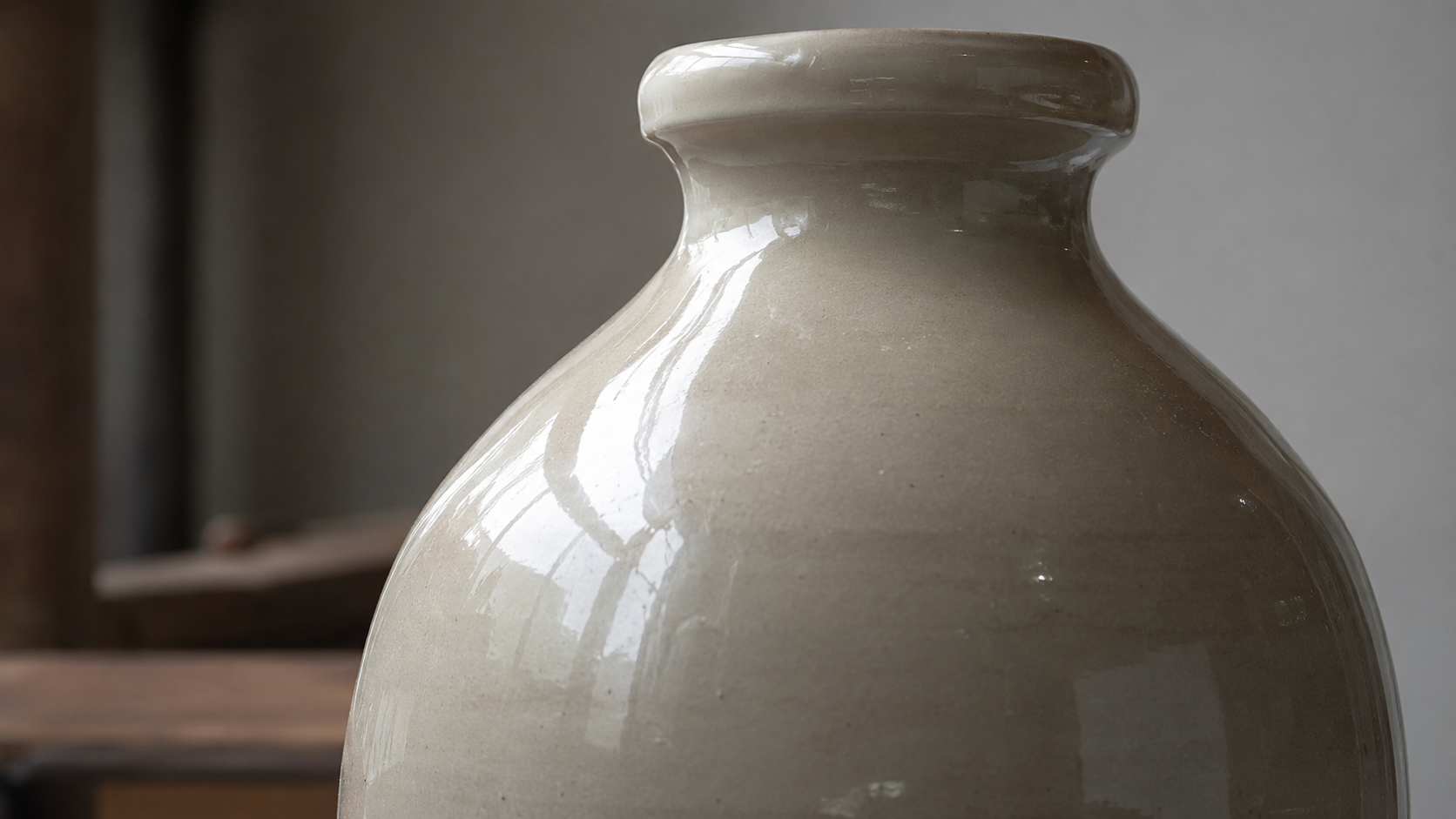
SPECIMEN IMAGE #16:9 - CLEAN OPTICS
Many AI-generated product images fall into the same visual trap: perfectly clean surfaces, mathematically uniform reflections, and exaggerated sharpness that ignores how real materials behave. A glossy ceramic vase is an excellent calibration target because its reflective surface immediately exposes synthetic shortcuts. Instead of chasing perfection, a camera-grade approach studies how glaze, curvature, reflections, and optical limitations interact in a physically believable image.
At first glance, the vase appears simple. Yet every reflection contains information about the environment, every highlight reveals surface geometry, and every shadow transition exposes lighting structure. In the breakdown below, we examine these physical layers individually. However, the deeper secret of realism does not emerge solely from visual analysis. It emerges from language calibration itself, and the most important clues are often hidden in the lexicon shifts revealed by the calibration console at the end of the dossier.
The lexicon shift process replaces synthetic vocabulary with observational vocabulary. Terms such as "perfect," "cinematic," or "ultra detailed" frequently push image models toward generic aesthetics rather than physical behavior. By replacing them with descriptions of reflection distortion, bounce-light contamination, highlight rolloff, dust visibility, lens softness, and sensor response, the prompt begins to simulate the way real cameras record information. Calibration quality can be measured through reflection plausibility, highlight energy distribution, surface continuity, optical degradation behavior, and the consistency between lighting geometry and material response.
This brings us back to the original problem: repetitive AI aesthetics often emerge from repetitive language. When creators learn to calibrate prompts through physical observation rather than visual hype, ordinary subjects become powerful realism studies. For a deeper film-style framework covering material behavior, optical realism, environmental entropy, and prompt calibration systems, explore ALPHA REALISM. The complete methodology, advanced calibration workflows, and creator-focused realism tools are documented inside ALPHA REALISM.
The 5 Layers of Reality Applied
Subject:
Close-up view of a polished ceramic vase with a glazed surface, rounded body geometry, subtle manufacturing irregularities, micro undulations in the glaze layer, faint edge transitions, realistic specular reflection behavior, visible curvature distortion across reflected shapes, and localized surface variation rather than perfectly uniform reflectivity.
Environment:
Indoor studio environment with large softbox illumination positioned outside the frame, diffuse light spill across the vase surface, gentle shadow gradients near the base, secondary reflection contamination from surrounding studio walls, subtle brightness falloff, and non-uniform reflected luminance caused by practical studio geometry.
Physics:
Specular reflections follow surface curvature, reflected softbox shapes stretch and compress according to vase geometry, gravity stabilizes object placement, indirect bounce light lifts darker regions, microscopic surface imperfections slightly disrupt reflection continuity, and energy-conserving highlight behavior prevents unrealistic brightness distribution.
Time:
Minor dust particles visible under strong illumination, faint handling marks near high-contact areas, slight glaze inconsistencies from manufacturing, subtle cleaning streak remnants, and realistic material aging that preserves overall condition without appearing factory-perfect.
Camera:
Full-frame digital camera simulation, 85mm macro lens, close focusing distance, shallow but physically plausible depth transition, slight edge softness, realistic highlight clipping behavior, restrained sharpening, mild sensor grain in darker regions, neutral white balance, and optical rendering that preserves material realism rather than synthetic hyper-detail.
The Lexicon Shift Table
| Appearance (Dead Adjective) |
|
Living Event (Cause & Effect) |
| perfect glossy vase |
➔ |
glazed ceramic vase showing subtle surface irregularities and realistic reflection distortion |
| cinematic studio lighting |
➔ |
large practical softbox illumination with natural bounce light and gradual exposure falloff |
| ultra sharp reflections |
➔ |
reflection edges softened by lens rendering and glaze microvariation |
| flawless product photography |
➔ |
observational close-up revealing dust traces, handling marks, and physical material behavior |
| hyper detailed surface |
➔ |
localized texture retention with realistic limits imposed by optics and sensor response |
Calibration Prompt Console
SUBJECT: Close-up of a polished glazed ceramic vase, rounded silhouette, realistic manufacturing variation, subtle glaze waviness, minor dust particles, faint handling marks, physically accurate specular reflections, reflection distortion following object curvature, no decorative embellishment added. ENVIRONMENT: Practical indoor studio setup, large softbox outside frame, diffuse ambient spill, reflected studio walls, gentle shadow gradients, realistic exposure distribution, non-uniform luminance behavior, observational product photography framing. PHYSICS: Curved reflective surface compressing and stretching reflected softbox shapes, indirect bounce illumination, physically plausible highlight rolloff, realistic reflection continuity, slight disruption from microscopic surface imperfections, stable object resting under gravity. TIME: Light signs of use, subtle cleaning streak remnants, faint dust accumulation visible only in strong highlights, realistic material aging without damage exaggeration, preserved ceramic authenticity. CAMERA: Full-frame digital camera, 85mm macro lens, close focusing distance, realistic depth transition, slight edge softness, restrained sharpening, natural sensor grain, neutral color science, practical optical rendering, no CGI appearance, no hyper-detail enhancement, camera-grade realism, documentary material fidelity --ar 16:9
Do you want to generate precise AI images?
Unlock our alpha realism blueprint, physical reliable framework to get the best of your creations with the ALPHA REALISM Guide.
Download Ebook Now