← BACK TO DOSSIERS LIST
REALISM CASE FILE // TREND: HOW AI MODELS GENERATE FAKE SYMMETRY THAT RUINS REALISM
Film-Style Symmetry: Camera-Grade Realism for a Vertically Split Human Face
DATE: 2026-07-20
STATUS: CALIBRATED_REALISM
ENGINE: CHATGPT DALL-E 3
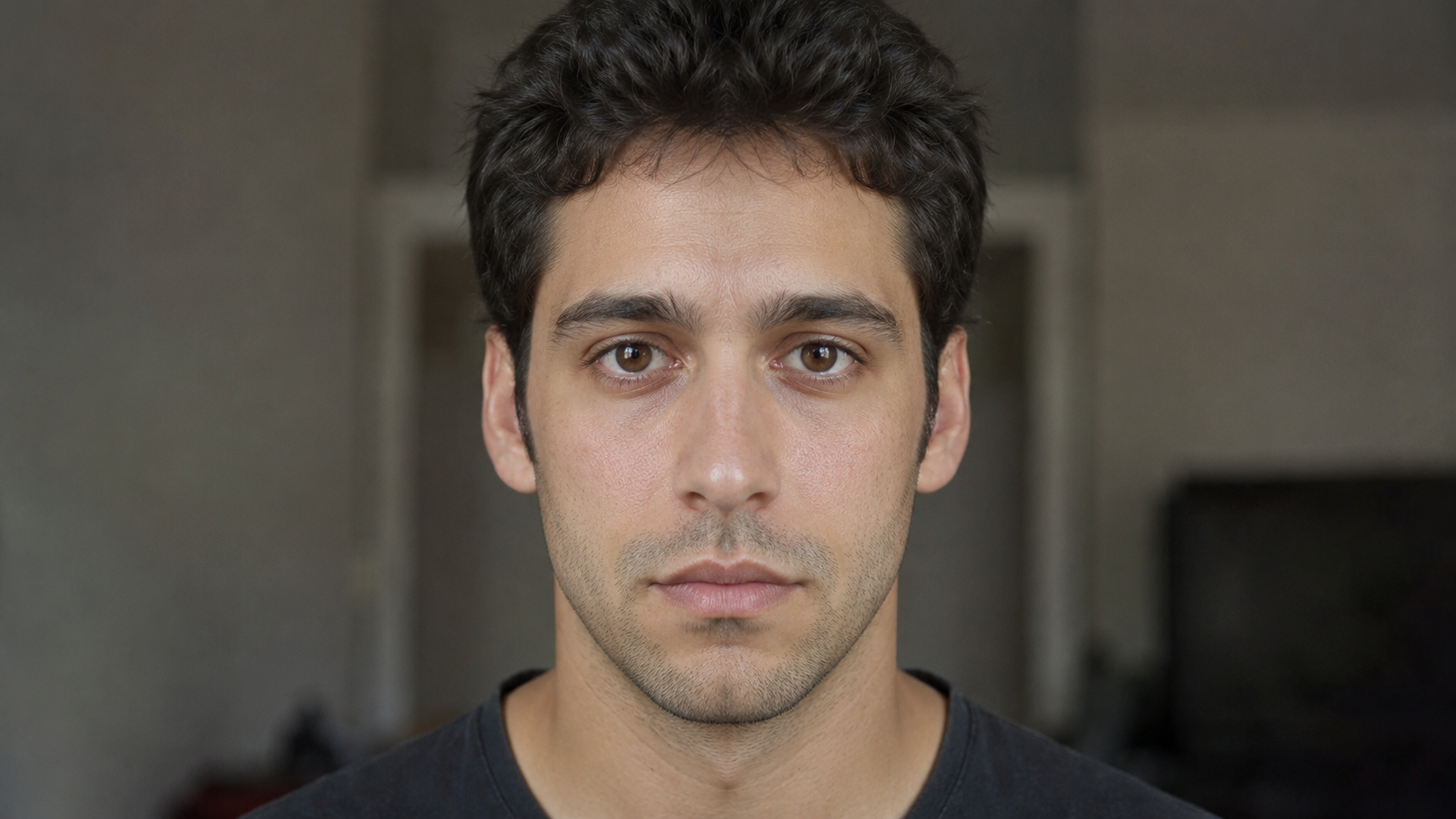
SPECIMEN IMAGE #16:9 - CLEAN OPTICS
Artificial intelligence image generation frequently defaults to repetitive visual formulas: flawless skin, exaggerated sharpness, cinematic lighting, and symmetry treated as aesthetic perfection. A portrait showing a face split exactly in half presents an opportunity to challenge those defaults. Rather than using symmetry as a shortcut to beauty, photo-realism treats it as a structural condition that must still obey the behavior of skin, optics, light, and physical capture limitations.
At first glance, absolute vertical symmetry appears simple. Yet the deeper question is what happens when symmetry is filtered through the realities of photography. Below, we break down the subject through five layers of reality—Subject, Environment, Physics, Time, and Camera. However, the true secret behind camera-grade simulation is not found in visual keywords alone. It emerges from language-level substitutions revealed in the calibration console through lexicon shifts that fundamentally alter how image models interpret realism.
The lexicon shift process replaces idealized vocabulary with physically observable phenomena. Terms such as "perfect skin" become descriptions of pore visibility, tonal variation, and texture behavior. "Cinematic lighting" becomes indirect environmental illumination with natural shadow distribution. Calibration metrics prioritize identity retention, realistic optical degradation, sensor behavior, highlight rolloff, and information loss patterns over aesthetic optimization. This produces imagery that behaves more like a photographed event and less like a rendered concept.
Returning to the original problem, the most convincing symmetrical face is rarely the most polished one. Realism emerges when mathematical symmetry coexists with believable skin response, practical lighting, and camera limitations. Creators seeking deeper control over these mechanisms can explore the methodology behind ALPHA REALISM. For a comprehensive framework covering film-style calibration, reality-layer analysis, and lexicon engineering, the complete ALPHA REALISM Guide provides a structured approach to building images that feel captured rather than generated.
The 5 Layers of Reality Applied
Subject:
A frontal portrait of a human face divided exactly along the vertical centerline, creating bilateral mirror symmetry while preserving natural skin texture, pore distribution, subtle facial tension, eyelid structure, lip texture, hairline irregularities, and realistic anatomical transitions. The face appears observational rather than idealized, with identity cues retained through skin variation, micro-asymmetry remnants, and natural human surface behavior.
Environment:
Neutral indoor environment illuminated by indirect window light. Soft ambient shadows fall evenly across both halves of the face, with slight luminance falloff near the cheeks and jawline. Background remains subdued and visually quiet, allowing attention to remain on the symmetry experiment without dramatic contrast or stylized lighting.
Physics:
Light reflects naturally across skin oils, pores, eyelashes, and lips. Gravity influences hair placement and subtle tissue compression around the jaw and neck. Surface reflections remain physically plausible, with no artificial glow, exaggerated specular highlights, or impossible symmetry artifacts.
Time:
Visible signs of ordinary human existence remain present, including minor skin fatigue, uneven pore visibility, faint discoloration shifts, subtle dryness around the lips, natural texture accumulation, and realistic age-dependent facial characteristics. No cosmetic restoration or temporal idealization is introduced.
Camera:
Documentary-style digital capture using a 50mm equivalent lens. Moderate sensor grain, realistic dynamic range limitations, slight edge softness, mild compression artifacts, imperfect microcontrast retention, and physically plausible skin detail rendering. No beauty filters, HDR exaggeration, or synthetic sharpness enhancement.
The Lexicon Shift Table
| Appearance (Dead Adjective) |
|
Living Event (Cause & Effect) |
| perfect symmetry |
➔ |
mathematically mirrored facial geometry retaining realistic skin behavior and optical imperfections |
| perfect skin |
➔ |
skin texture showing subtle pores, tonal variation, and localized microcontrast loss |
| cinematic lighting |
➔ |
indirect window illumination with natural ambient shadow falloff |
| hyper detailed face |
➔ |
realistic facial detail with selective texture retention and natural information loss |
| flawless portrait |
➔ |
documentary-style facial study preserving ordinary human surface irregularities |
| ultra sharp |
➔ |
moderately resolved image with realistic lens softness and sensor limitations |
| photorealistic masterpiece |
➔ |
observational portrait consistent with real camera capture behavior |
| studio quality |
➔ |
practical indoor capture with uncontrolled environmental light characteristics |
Calibration Prompt Console
SUBJECT: frontal portrait of a human face split exactly along the vertical centerline, absolute bilateral symmetry across facial structure, realistic skin texture, visible pores, natural lip texture, preserved hairline behavior, subtle facial tension, ordinary human appearance, no beautification, no cosmetic cleanup. ENVIRONMENT: neutral indoor setting, indirect window light, subdued background, soft ambient shadows, observational photographic atmosphere, non-stylized surroundings. PHYSICS: physically plausible skin reflections, realistic highlight rolloff, gravity-dependent hair placement, natural tissue compression, accurate shadow behavior, no artificial glow. TIME: subtle signs of skin fatigue, minor tonal inconsistencies, realistic age traces, natural texture wear, authentic human surface variation. CAMERA: documentary photography, 50mm equivalent lens, moderate sensor grain, realistic dynamic range limitations, slight edge softness, mild compression artifacts, natural focus behavior, no HDR exaggeration, no beauty filter, no synthetic sharpness, camera-grade realism, observational capture --ar 16:9
Do you want to generate precise AI images?
Unlock our alpha realism blueprint, physical reliable framework to get the best of your creations with the ALPHA REALISM Guide.
Download Ebook Now