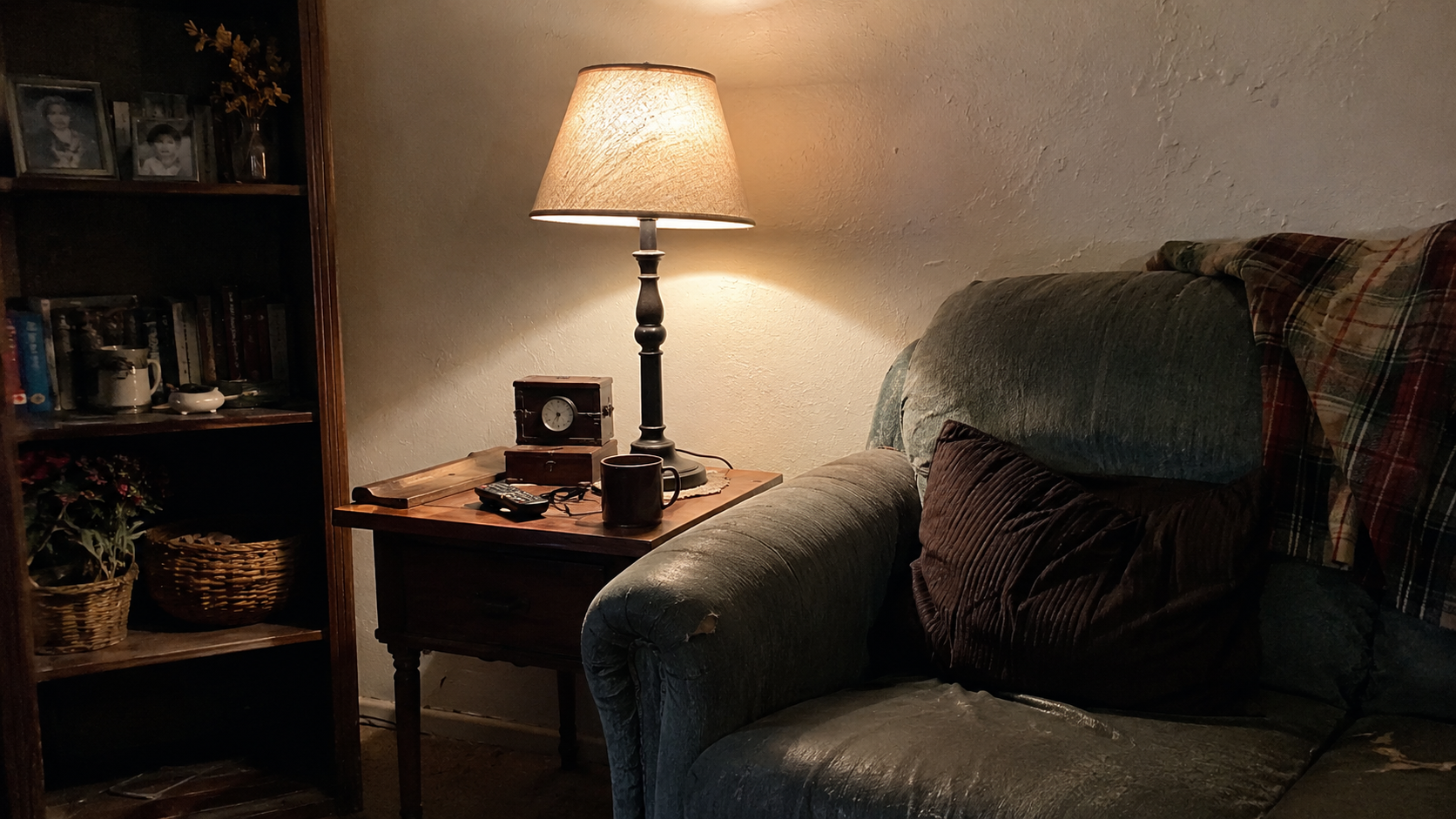
Many AI-generated interior photographs fall into the same visual trap: immaculate furniture, exaggerated contrast, and decorative perfection that rarely exists in real homes. A simple living room corner illuminated by a table lamp becomes far more believable when realism emerges from ordinary material behavior, subtle wear, uneven object placement, and soft shadow transitions shaped by actual physical conditions rather than aesthetic optimization.
In this calibration study, we will break down the physical structure of a lamp-lit living room corner through the five layers of reality: Subject, Environment, Physics, Time, and Camera. These layers reveal how believable imagery is constructed from observational details rather than visual spectacle. Yet the deeper lesson appears later in the calibration process, where language itself becomes the hidden variable. The true secret to mastering camera-grade simulation lies in the lexicon shifts revealed in the calibration console at the end of the dossier.
Lexicon shifts replace abstract aesthetic commands with physically measurable descriptions. Instead of requesting cinematic lighting, the prompt specifies practical lamp illumination and uneven ambient falloff. Instead of perfect interior design, it describes realistic object spacing and lived-in asymmetry. Calibration metrics focus on shadow diffusion, material aging, optical imperfections, sensor behavior, luminance distribution, and environmental entropy. Each lexical substitution increases physical plausibility while reducing the repetitive visual signatures commonly associated with synthetic imagery.
The result is a scene that returns to the original challenge: representing an ordinary living room corner without defaulting to generic AI aesthetics. By grounding every visual element in observable behavior, creators gain more control over realism and consistency. For a deeper framework covering film-style calibration, layered reality analysis, and advanced lexicon engineering, explore ALPHA REALISM. If your goal is reliable camera-grade image simulation rather than aesthetic guesswork, the methodologies documented in ALPHA REALISM provide a structured path toward physically believable visual generation.
The 5 Layers of Reality Applied
Subject:
A quiet living room corner containing a small side table, a practical table lamp with a fabric shade, a worn upholstered chair, and ordinary household objects positioned without decorative symmetry. The scene feels lived-in rather than staged, with subtle clutter, uneven object spacing, and realistic material wear.
Environment:
Soft lamp illumination falls across an off-white plaster wall, creating diffuse shadows with gradual edge transitions. Ambient room light mixes with the lamp's warmer color temperature, producing uneven luminance zones, slight shadow contamination, and realistic brightness falloff near corners and furniture edges.
Physics:
Light radiates from the lamp shade and interacts with the rough plaster surface through scattering and absorption. Shadows become softer as distance increases from the casting objects. Minor reflections emerge from varnished wood and fabric fibers. Gravity influences the drape of textiles, while accumulated dust slightly reduces surface reflectivity.
Time:
The wall shows faint discoloration, subtle paint wear, and minor texture inconsistencies. Furniture fabrics exhibit light compression, softened edges, and everyday aging. Dust accumulation is visible along baseboards and on horizontal surfaces. Materials display realistic fatigue from long-term domestic use.
Camera:
Documentary-style indoor photograph captured with a consumer-grade smartphone equivalent to a 26mm lens. Slight edge softness, mild HDR flattening, subtle sensor noise in shadow regions, imperfect white balance adaptation, gentle compression artifacts, realistic highlight rolloff, and natural handheld capture characteristics.
The Lexicon Shift Table
| Appearance (Dead Adjective) |
|
Living Event (Cause & Effect) |
| cinematic lighting |
➔ |
practical table lamp illumination creating uneven ambient falloff across textured plaster |
| perfect interior design |
➔ |
ordinary living room arrangement with realistic object spacing and lived-in asymmetry |
| dramatic shadows |
➔ |
soft shadow gradients shaped by lamp diffusion and wall texture |
| ultra detailed wall |
➔ |
plaster surface showing subtle imperfections, paint variation, and localized wear |
| luxury furniture |
➔ |
practical household furniture displaying mild material fatigue and everyday use |
| photorealistic masterpiece |
➔ |
observational indoor photograph with realistic optical and sensor limitations |
SUBJECT: A cozy living room corner containing a small wooden side table, a practical table lamp with a fabric shade, a worn upholstered chair, and ordinary household objects arranged naturally without decorative perfection. ENVIRONMENT: Off-white plaster wall with visible texture variation, subtle paint inconsistencies, realistic domestic clutter, lived-in spatial asymmetry, soft ambient room illumination blending with warm lamp light. PHYSICS: Lamp-generated shadows spreading across the plaster wall with gradual edge diffusion, realistic light scattering, mild reflections from wood and fabric, gravity-dependent textile draping, physically plausible brightness falloff. TIME: Light wall discoloration, minor surface wear, dust accumulation on horizontal surfaces, softened furniture edges, signs of long-term domestic use, subtle environmental aging. CAMERA: Documentary indoor photography, consumer smartphone equivalent, 26mm lens, slight edge softness, mild HDR flattening, low-level sensor grain in shadow regions, realistic dynamic range limitations, gentle compression artifacts, natural handheld capture behavior, observational realism, non-editorial composition, practical lighting behavior --ar 16:9