← BACK TO DOSSIERS LIST
REALISM CASE FILE // TREND: WHY YOU SHOULD STOP USING CINEMATIC LIGHTING IN PROMPTS
Photo-Realism Calibration for Movie Set Lighting: Building a Camera-Grade Production Scene
DATE: 2026-07-20
STATUS: CALIBRATED_REALISM
ENGINE: CHATGPT DALL-E 3
SPECIMEN IMAGE #16:9 - CLEAN OPTICS
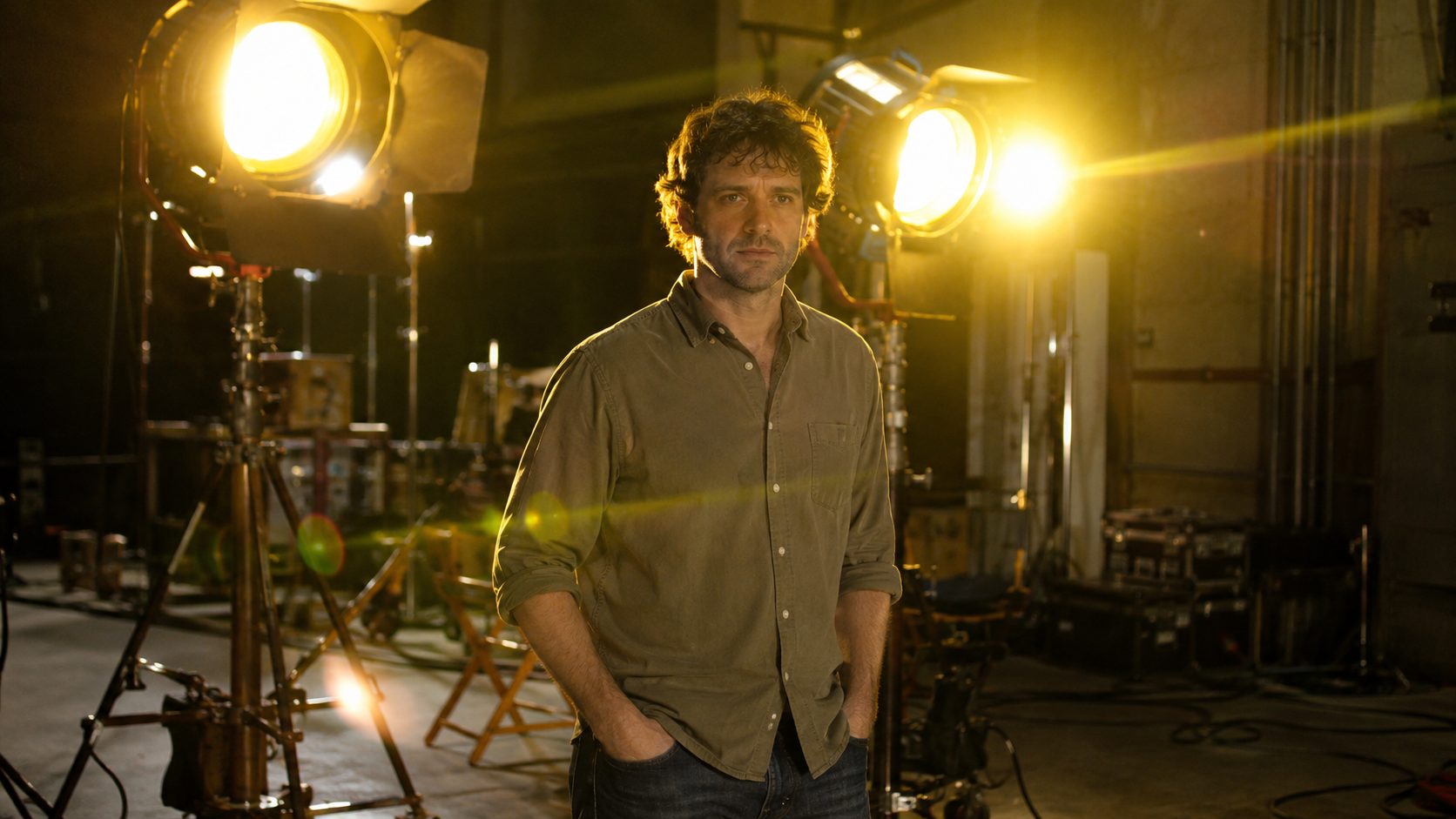
Movie production imagery is frequently reduced to a predictable collection of AI aesthetics: flawless actors, mathematically clean lighting, and synthetic lens flares that behave more like graphic overlays than optical events. Real production environments operate differently. Large yellow spotlights introduce uneven illumination, exposure instability, practical glare, and visual contamination that interact with both the environment and the camera system in physically observable ways.
In the breakdown below, we examine the scene through five layers of reality: Subject, Environment, Physics, Time, and Camera. Each layer contributes information that helps separate a believable production photograph from a generic rendered image. Yet the most important factor is often hidden at the language level. The calibration console at the end of the dossier reveals how subtle lexical substitutions alter the entire simulation outcome, transforming aesthetic descriptions into physically grounded observations.
The lexicon shift process replaces abstract visual shortcuts with measurable photographic behavior. Terms such as "cinematic lighting" become descriptions of practical spotlights, flare contamination, and uneven luminance distribution. Likewise, references to perfection are exchanged for observable characteristics including texture variation, equipment wear, environmental clutter, and realistic optical limitations. These calibration metrics increase physical plausibility because they describe how information behaves inside a camera system rather than how an idealized scene should appear.
This returns us to the original problem: repetitive AI imagery is often generated from repetitive language. By understanding the five layers of reality and applying structured lexicon shifts, creators can build scenes that feel observational instead of synthetic. For a deeper framework covering film-style calibration, camera-grade prompting, and realism engineering workflows, explore ALPHA REALISM. The complete methodology, additional calibration systems, and advanced realism dossiers are available through ALPHA REALISM.
The 5 Layers of Reality Applied
Subject:
A film actor standing under multiple large yellow production spotlights, maintaining a natural stance with uneven weight distribution, subtle facial tension, ordinary grooming, realistic clothing wrinkles, and non-performative body language while awaiting direction between takes.
Environment:
A working movie production set filled with lighting stands, power cables, grip equipment, scattered cases, practical staging elements, uneven illumination, bright yellow spotlights aimed toward the actor, lens flare contamination, localized shadow loss, and overlapping visual clutter consistent with an active filming environment.
Physics:
Strong directional light generates flare streaks, internal lens reflections, highlight bloom, reflective spill on nearby surfaces, gravity-driven fabric folds, slight heat haze near lighting equipment, realistic shadow falloff, and optical contrast reduction caused by intense practical light sources.
Time:
Minor wear on equipment surfaces, scuffed floor markings, dust accumulation on cases, fingerprints on metallic hardware, fabric fatigue in wardrobe details, cable aging, and subtle signs of repeated production use visible throughout the set.
Camera:
Documentary-style capture using a practical cinema or mirrorless camera, slight sensor grain, imperfect highlight retention, realistic flare behavior, mild edge softness, localized focus inconsistency, natural exposure clipping around spotlights, and physically plausible optical contamination from bright light sources.
The Lexicon Shift Table
| Appearance (Dead Adjective) |
|
Living Event (Cause & Effect) |
| cinematic lighting |
➔ |
large yellow production spotlights producing practical glare, flare streaks, and uneven illumination |
| perfect actor |
➔ |
actor with ordinary facial texture, natural posture drift, and subtle expression asymmetry |
| clean movie set |
➔ |
working production environment with cables, cases, equipment wear, and practical clutter |
| dramatic lens flare |
➔ |
optically plausible flare contamination caused by direct spotlight intrusion into the lens |
| ultra sharp image |
➔ |
localized sharpness variation with realistic optical softness near frame edges |
| perfect shadows |
➔ |
mixed shadow density with partial recovery loss near intense practical lights |
Calibration Prompt Console
SUBJECT: A film actor standing beneath multiple oversized yellow production spotlights, natural body imbalance, realistic clothing wrinkles, ordinary grooming, subtle facial asymmetry, non-performative posture, waiting between takes. ENVIRONMENT: Active movie production set with lighting rigs, grip stands, power cables, equipment cases, practical staging clutter, uneven spacing, overlapping production hardware, bright yellow spotlights aimed toward the actor. PHYSICS: Intense directional light creating realistic lens flare streaks, ghost reflections, highlight bloom, exposure instability near practical lights, gravity-driven fabric behavior, reflective spill, mild atmospheric diffusion. TIME: Signs of repeated production use including dust accumulation, scuffed floor markings, worn equipment surfaces, cable fatigue, slight material aging, authentic workplace wear. CAMERA: Documentary-style capture, practical cinema camera behavior, natural sensor grain, slight highlight clipping, realistic flare contamination, mild edge softness, imperfect focus consistency, optical haze from bright light intrusion, physically plausible exposure response, anti-CGI realism, observational photography behavior, aspect ratio --ar 16:9
Do you want to generate precise AI images?
Unlock our alpha realism blueprint, physical reliable framework to get the best of your creations with the ALPHA REALISM Guide.
Download Ebook Now