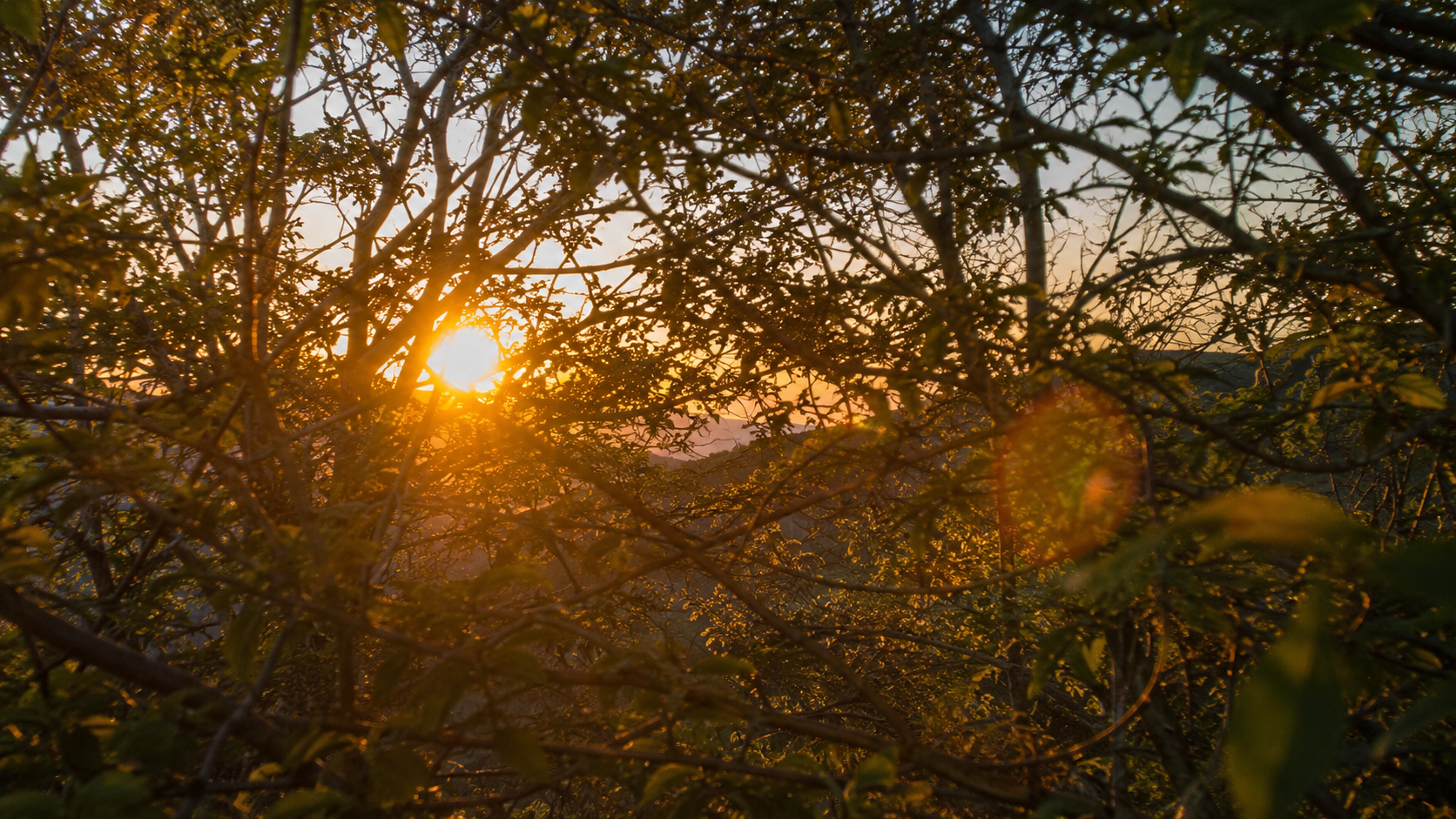
Artificial image generators often converge toward the same polished sunset aesthetic: flawless gradients, mathematically clean silhouettes, and exaggerated lens effects that rarely resemble how cameras actually record light. A believable sunset photographed through trees depends far more on imperfect optical behavior, uneven foliage density, atmospheric scattering, and the physical limitations of real camera systems than on visual exaggeration. :contentReference[oaicite:0]{index=0} :contentReference[oaicite:1]{index=1}
The physical characteristics listed below are only part of the calibration process. The deeper transformation occurs at the language level, where small lexical substitutions redefine how an image model interprets optics, environment, sensor behavior, and material reality. The calibration console presented at the end of the dossier reveals why replacing idealized vocabulary with physically descriptive terminology consistently produces more camera-grade simulations. :contentReference[oaicite:2]{index=2} :contentReference[oaicite:3]{index=3}
Lexicon shifts replace abstract aesthetic language with measurable physical observations. Expressions such as "cinematic lighting" become descriptions of available sunlight interacting with foliage, while "perfect lens flare" becomes an asymmetrical optical reflection generated by internal lens elements. Similar substitutions describe sensor limitations, atmospheric diffusion, chromatic aberration, highlight rolloff, and edge softness, allowing prompts to encode photographic behavior instead of visual style. This calibration process improves realism by describing observable phenomena rather than artistic intent. :contentReference[oaicite:4]{index=4} :contentReference[oaicite:5]{index=5}
Returning to the original problem, believable realism is achieved not by adding more detail, but by describing how real cameras lose, distort, and redistribute information under physical constraints. The complete methodology is explored in the ALPHA REALISM Guide, where film-style calibration techniques, layered prompt engineering, and lexicon-shift strategies are documented in depth. For creators seeking repeatable camera-grade realism instead of repetitive AI aesthetics, the ALPHA REALISM framework provides a structured approach grounded in observable photographic behavior.
The 5 Layers of Reality Applied
Subject:
A late-day sunset viewed through irregular tree branches, with the sun partially obscured by foliage, producing a naturally occurring warm circular lens flare. The branches remain unevenly distributed, leaves vary in density, and no element appears artificially arranged or perfectly symmetrical.
Environment:
Low-angle golden sunlight filters through overlapping foliage, creating scattered illumination, soft shadow transitions, localized highlight clipping, atmospheric haze, and uneven brightness caused by the natural obstruction of leaves and branches rather than controlled lighting.
Physics:
Light scatters through humid air while interacting with the camera optics, producing internal reflections, a warm circular flare, subtle ghost reflections, gentle chromatic edge separation, slight veiling glare, and soft edge aberrations. Minor wind movement causes irregular leaf positioning and subtle motion variation.
Time:
Leaves display small natural imperfections, slight seasonal discoloration, occasional dust accumulation, minor twig irregularities, and realistic environmental aging. Atmospheric particles slightly soften distant detail while preserving the appearance of an ordinary outdoor scene.
Camera:
Documentary-style digital photograph captured with a consumer mirrorless or smartphone-class lens exhibiting mild edge softness, slight corner degradation, subtle chromatic aberration near high-contrast foliage edges, natural highlight rolloff, restrained sensor grain, gentle compression artifacts, realistic dynamic range limitations, and authentic optical flare behavior without exaggerated cinematic processing.
The Lexicon Shift Table
| Appearance (Dead Adjective) |
|
Living Event (Cause & Effect) |
| cinematic lighting |
➔ |
available late-afternoon sunlight scattered through overlapping tree foliage |
| perfect lens flare |
➔ |
warm circular internal lens reflection with slight asymmetry |
| ultra sharp leaves |
➔ |
localized foliage sharpness with natural edge softness |
| perfect sunset colors |
➔ |
uneven golden-hour color transitions influenced by atmospheric haze |
| dramatic glow |
➔ |
physically plausible highlight bloom caused by optical reflections |
| crystal clear optics |
➔ |
consumer-grade lens rendering with subtle aberrations and flare contamination |
Subject Layer: A documentary-style photograph of a sunset partially visible through naturally irregular tree branches and uneven foliage, preserving organic spacing and realistic vegetation density. Environment Layer: Available golden-hour sunlight filtering through leaves with uncontrolled illumination, soft shadow transitions, atmospheric haze, realistic highlight clipping, and ordinary outdoor visual complexity. Physics Layer: Warm circular lens flare created by genuine internal optical reflections, subtle ghost reflections, soft edge aberrations, slight chromatic fringing near bright branch edges, mild veiling glare, humidity-softened air, and gentle wind producing irregular leaf movement. Time Layer: Natural seasonal wear, slight discoloration in leaves, imperfect branch geometry, accumulated environmental dust, realistic atmospheric depth, and authentic outdoor aging. Camera Layer: Consumer digital camera or smartphone-grade optics, mild corner softness, restrained sensor grain, realistic compression behavior, moderate HDR limitations, subtle lens contamination, natural optical imperfections, documentary realism, no artificial beautification, no exaggerated cinematic grading, no hyperreal sharpening, no synthetic perfection --ar 16:9