← BACK TO DOSSIERS LIST
REALISM CASE FILE // TREND: MIDJOURNEY V6 VS DALL-E 3: WHICH MODEL HANDLES THE 5 LAYERS BEST
Film-Style Lens Calibration: Building Camera-Grade Split-Screen Portrait Comparisons Through Physical Realism
DATE: 2026-06-30
STATUS: CALIBRATED_REALISM
ENGINE: CHATGPT DALL-E 3
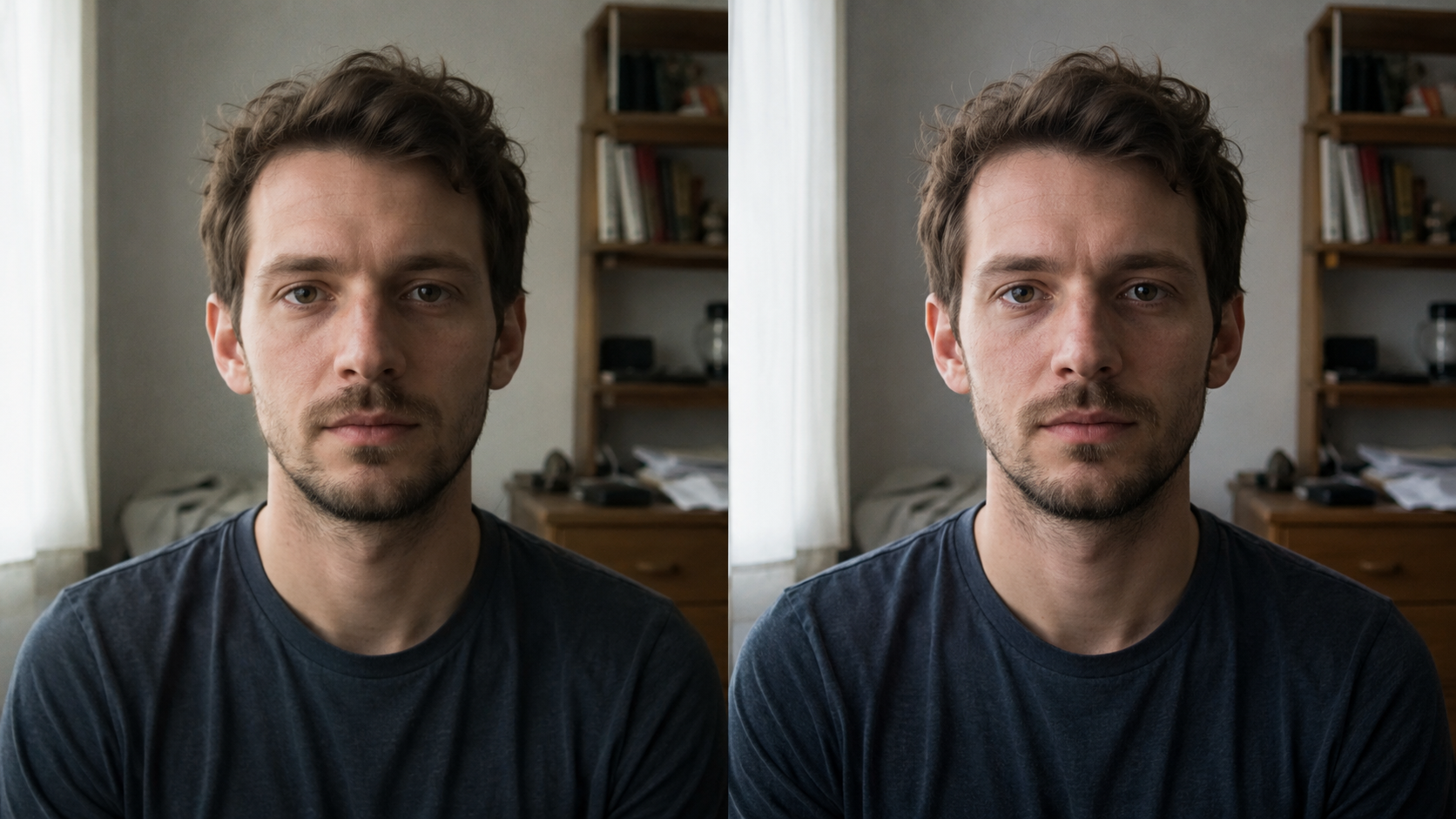
SPECIMEN IMAGE #16:9 - CLEAN OPTICS
Artificial intelligence often defaults to visually repetitive portraits where every face appears polished, every lens behaves identically, and every image converges toward the same aesthetic. A film-style comparison reveals that authentic photography is defined by small optical inconsistencies rather than dramatic stylistic differences. Camera-grade realism begins when those subtle behaviors become measurable instead of decorative.
The comparison shown here is more than a side-by-side image. It is an opportunity to examine how physical optics influence perception without changing identity. We will break down the physical characteristics layer by layer, but the true secret to mastering camera-grade simulation lies in language-level shifts revealed in the calibration console at the end of the dossier, where seemingly small vocabulary changes consistently produce more believable optical behavior.
The five reality layers isolate different physical mechanisms: the subject preserves structural identity, the environment controls illumination, physics governs light transport and optical imperfections, time introduces authentic wear, and the camera layer defines lens and sensor behavior. The lexicon shift table transforms abstract terms such as "perfect skin" into physically observable descriptions that reference pores, light interaction, texture retention, and realistic optical limitations. This calibration strategy reduces synthetic appearance because the language describes measurable image behavior instead of idealized aesthetics.
Returning to the original comparison, the most convincing difference is not increased sharpness but believable variation in optical rendering while the subject remains unmistakably the same. That philosophy extends throughout the ALPHA REALISM methodology, where film-style observation replaces visual exaggeration. If you want a deeper calibration framework for camera-grade prompting, optical diagnostics, and lexicon engineering, explore the complete ALPHA REALISM Guide. :contentReference[oaicite:0]{index=0}
The 5 Layers of Reality Applied
Subject:
A split-screen comparison presenting the same adult subject in two realistic portraits captured from nearly identical framing, with subtle differences caused by lens calibration rather than identity changes. Facial proportions remain consistent while edge rendering, microcontrast, field curvature, skin texture retention, eyebrow definition, hair strand separation, and eye sharpness vary naturally without beautification. Clothing, posture, expression, and accessories remain unchanged between both panels.
Environment:
Neutral indoor environment illuminated by diffuse window light mixed with weak ambient room lighting. Soft shadow transitions, slight exposure imbalance between both halves, realistic highlight clipping near the brightest areas, ordinary background objects with mild visual clutter, and naturally uneven illumination across the frame.
Physics:
Light scatters differently through each optical calibration, producing subtle variations in edge acuity, contrast falloff, chromatic fringing, veiling glare, reflection intensity, and depth rendering. Gravity preserves identical clothing folds while natural optical imperfections alter local detail retention instead of scene geometry.
Time:
Minor signs of ordinary use remain visible, including faint skin fatigue, subtle pore variation, realistic fabric wrinkles, slight dust accumulation on background surfaces, small material wear, and naturally aged environmental textures without restoration or cosmetic cleanup.
Camera:
Two simulated full-frame camera captures using slightly different lens calibration profiles. Left panel emphasizes modest edge softness, lower microcontrast, and faint chromatic aberration. Right panel exhibits improved center sharpness with realistic field curvature, gentle corner softness, physically plausible sensor grain, restrained sharpening, mild compression artifacts, natural highlight rolloff, and documentary-grade optical behavior.
The Lexicon Shift Table
| Appearance (Dead Adjective) |
|
Living Event (Cause & Effect) |
| perfect skin |
➔ |
skin texture showing subtle pores under diffuse window light |
| cinematic lighting |
➔ |
mixed ambient window light with uneven practical illumination |
| ultra sharp portrait |
➔ |
center-focused sharpness with realistic edge softness |
| flawless lens |
➔ |
lens exhibiting slight field curvature and chromatic fringing |
| studio background |
➔ |
ordinary lived-in interior with subtle environmental clutter |
| hyper detailed face |
➔ |
localized facial detail retention limited by realistic optics and sensor behavior |
Calibration Prompt Console
Subject Layer: Split-screen comparison of two realistic portraits of the same individual with identical composition, posture, clothing, facial structure and expression, preserving identity while demonstrating subtle lens calibration differences only. Environment Layer: Neutral indoor setting with diffuse window illumination, practical ambient lighting, ordinary background clutter, natural shadow variation and realistic highlight clipping. Physics Layer: Slight optical calibration changes affecting edge sharpness, microcontrast, chromatic aberration, field curvature, veiling glare, depth rendering and local texture retention without altering subject geometry. Time Layer: Slight skin fatigue, visible fabric wrinkles, minor environmental wear, naturally aged surfaces, realistic dust accumulation and authentic material imperfections. Camera Layer: Simulated full-frame capture, left portrait with gentle edge softness and restrained contrast, right portrait with slightly improved center acuity, realistic sensor grain, mild compression artifacts, subtle optical imperfections, physically plausible focus transition, documentary realism, no beautification, no CGI appearance, no exaggerated HDR, no artificial bokeh, no cinematic grading --ar 16:9
Do you want to generate precise AI images?
Unlock our alpha realism blueprint, physical reliable framework to get the best of your creations with the ALPHA REALISM Guide.
Download Ebook Now